
August 13, 2026
"I think it's excessive. I feel like I'm being milked."
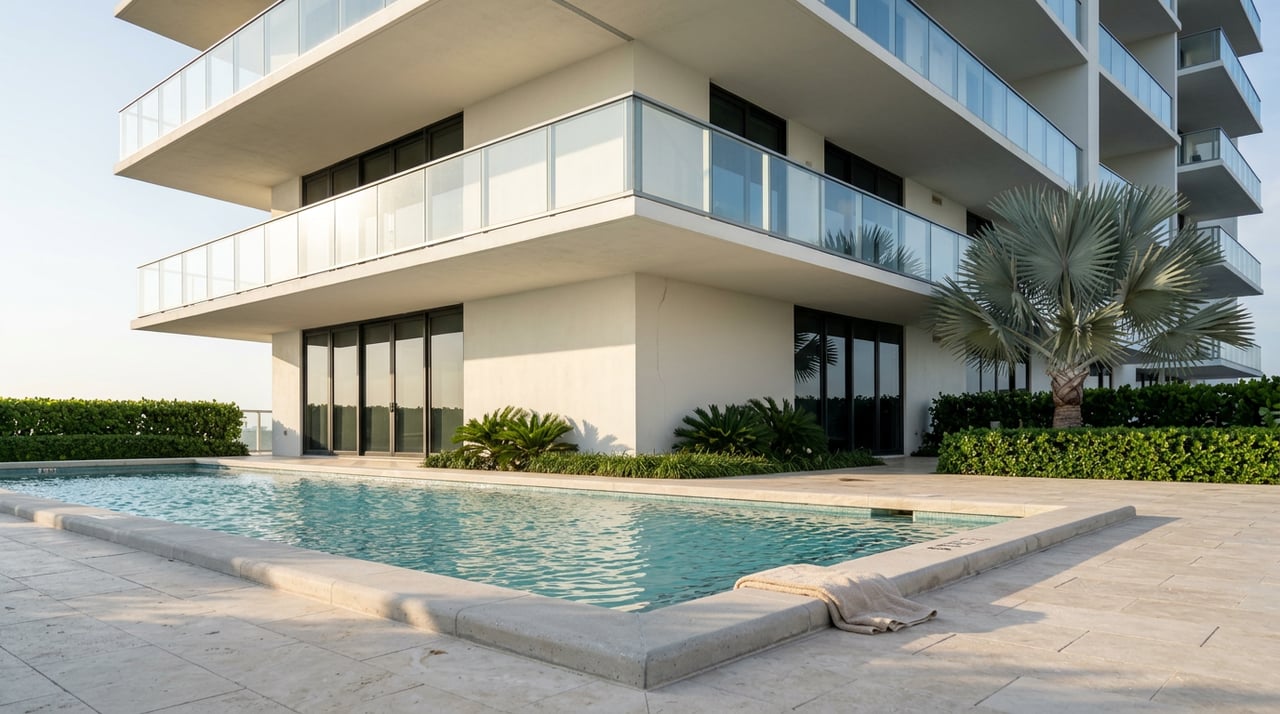
A resident of 1060 Brickell said that to CBS News after his condo board approved a $21 million special assessment on two towers that were only sixteen years old. Some owners were billed more than $40,000 apiece, for facade repairs on Tower 2, a full roof replacement, and pool deck restoration. Sixteen years is nothing for a building. It is barely enough time to pay off a car loan twice over. And yet the assessment landed anyway, because the study that found the problem was not looking at how old the building was. It was looking at how much money the association had actually saved.
That distinction is the whole story of Miami's condo market right now, and most of the coverage misses it.
Here is the number that should stop a buyer mid-scroll. In June 2026, according to the Miami Association of Realtors, single-family homes in Miami-Dade County had 4.9 months of supply, a seller's market by any standard definition. Existing condos, in the same county, in the same month, had 12.3 months of supply, a buyer's market by a wide margin.
| Metric, Miami-Dade, June 2026 | Single-family homes | Existing condos |
|---|---|---|
| Months of supply | 4.9 (seller's market) | 12.3 (buyer's market) |
| Median days to contract | 52 | 85 |
| Median days to sale, including closing | 94 | 124 |
Same county. Same interest rates. Same buyer pool, largely. Two entirely different markets. If mortgage rates or affordability explained the softness, houses and condos would be moving together. They are not. Something specific to condominium ownership, and not to Miami real estate generally, is doing the work.
The Champlain Towers South collapse in Surfside in 2021 killed 98 people. The following year, the Florida legislature passed Senate Bill 4-D, later refined by SB 154 in 2023 and HB 913 in 2025. Together these laws created two mandates for any condominium or cooperative building three stories or taller: a milestone structural inspection at 25 or 30 years of age depending on coastal proximity, and a Structural Integrity Reserve Study, known as a SIRS, that forces the association to calculate exactly what it will cost to maintain the roof, the load bearing walls, the foundation, waterproofing, and several other structural components, and then save toward that number on a fixed schedule.
Before 2022, Florida condo boards could vote to waive or underfund those reserves, year after year, to keep monthly dues artificially low. It was legal, it was common, and it is why so many buyers assumed a condo with a $400 monthly fee was simply a good deal. As of budgets adopted on or after January 1, 2025, that waiver is no longer available for the structural items a SIRS covers. Full reserve funding was required to begin with 2026 budgets, according to the Florida Department of Business and Professional Regulation. The initial SIRS deadline of December 31, 2025 has already passed for most affected buildings. The final coordinated deadline, for associations that paired their SIRS with a milestone inspection, is December 31, 2026, less than five months from now.
In other words, the decades of deferred savings are due now, in real dollars, on real buildings, in the exact market a buyer is looking at today.
These are not projections. They are assessments that have already been approved, billed, or litigated.
The last two figures are drawn from engineering firm Building Mavens' compliance guide, which points out that none of these were sudden structural failures. They were the predictable arrival of costs that had been legal to defer for years and, as of 2025, are no longer legal to defer at all.
Look at Miami's overall luxury condo numbers for Q1 2026 and the picture gets clearer, not muddier. Price per square foot across the luxury segment softened close to 4 percent year over year, yet the median sale price actually rose over 2 percent in the same period. That combination only makes sense if buyers are paying more for newer, better capitalized buildings while systematically discounting older stock. The average is falling because the bottom of the market, the pre-2000s towers with thin reserves, is being repriced hard. The top of the market, branded new construction with fully funded reserves baked into the pro forma from day one, is holding or gaining.
That is why a building's age now matters more to the true cost of ownership than its zip code. Two condos with an identical view can carry entirely different financial exposure depending on whether their reserve fund is 80 percent funded or 30 percent funded. A buyer comparing an Edgewater high-rise from the early 2000s to a fifteen-year-newer Brickell tower is not just comparing neighborhoods. They are comparing two different funding histories that will determine whether a $30,000 special assessment shows up in year three of ownership.
Florida law, through Statute 718.407 and the disclosure requirements layered on by HB 913 and HB 1021, now requires associations to inform buyers of current, pending, and anticipated special assessments before closing. Every serious Miami condo purchase should include a request for these three items before an offer goes in, not after:
If an association cannot produce these within a reasonable window, that delay is itself information. Boards in full compliance tend to have this paperwork ready, because as of January 1, 2026, associations with 25 or more units are required to post these records for owner access in the first place.
For buyers weighing a Miami high-rise against newer product, or against a different kind of ownership entirely, the SIRS and milestone report are not paperwork to skim. They are the second price tag on the unit, and in some of the buildings above, the second price tag turned out to be larger than the first. That does not make Miami condo ownership a bad idea. Buildings with strong reserves, current inspections, and transparent boards are absorbing this transition without drama, and their pricing reflects it. It does mean that reading a Miami condo purchase off the median price alone, the way a buyer might size up a single-family home, misses the variable that actually decides the outcome.
Does the SIRS and milestone inspection requirement apply to single-family homes or townhomes? No. Both requirements apply only to condominium and cooperative buildings three or more habitable stories in height, which is part of why Miami-Dade's single-family and condo markets are behaving so differently in 2026.
What is the difference between a SIRS and a milestone inspection? A SIRS is a financial planning document. It estimates the useful life and replacement cost of structural components and sets a reserve funding schedule. A milestone inspection is a physical structural evaluation performed by a licensed engineer or architect once a building reaches the statutory age threshold. Buildings often need both, and Florida law allows them to be coordinated when both are due by the same deadline.
Can a board still vote to waive reserve funding to keep dues lower? Not for the structural components a SIRS covers, if the budget was adopted on or after January 1, 2025. Non-structural items like landscaping or clubhouse furnishings can still be waived by member vote.
Should I ask for these documents before writing an offer or wait until the inspection period? Before. A missing or incomplete SIRS, or an association that cannot produce a current assessment disclosure within a few business days, is worth knowing before you are under contract, not during your inspection window.
Reading a Miami reserve study and a milestone inspection report takes a trained eye, and the difference between a building that is simply older and one that is quietly underfunded is not always obvious on the surface. If you are weighing Miami condo product against other South Florida ownership options, from waterfront estates to newer construction, the Aaron Buchbinder Group can walk through the specific building documents with you before you write an offer. Request a private consultation.
Stay up to date on the latest real estate trends.
Boca Raton, FL
Six under-the-radar enclaves where privacy, acreage, and character rival Boca's biggest names.
Buying
Inside Look Into South Florida's Luxury Market

Design, Renovation & Remodeling
Where high-end design meets a smart return on your investment.
101 N Federal Hwy 5th Fl
Boca Raton FL 33432